
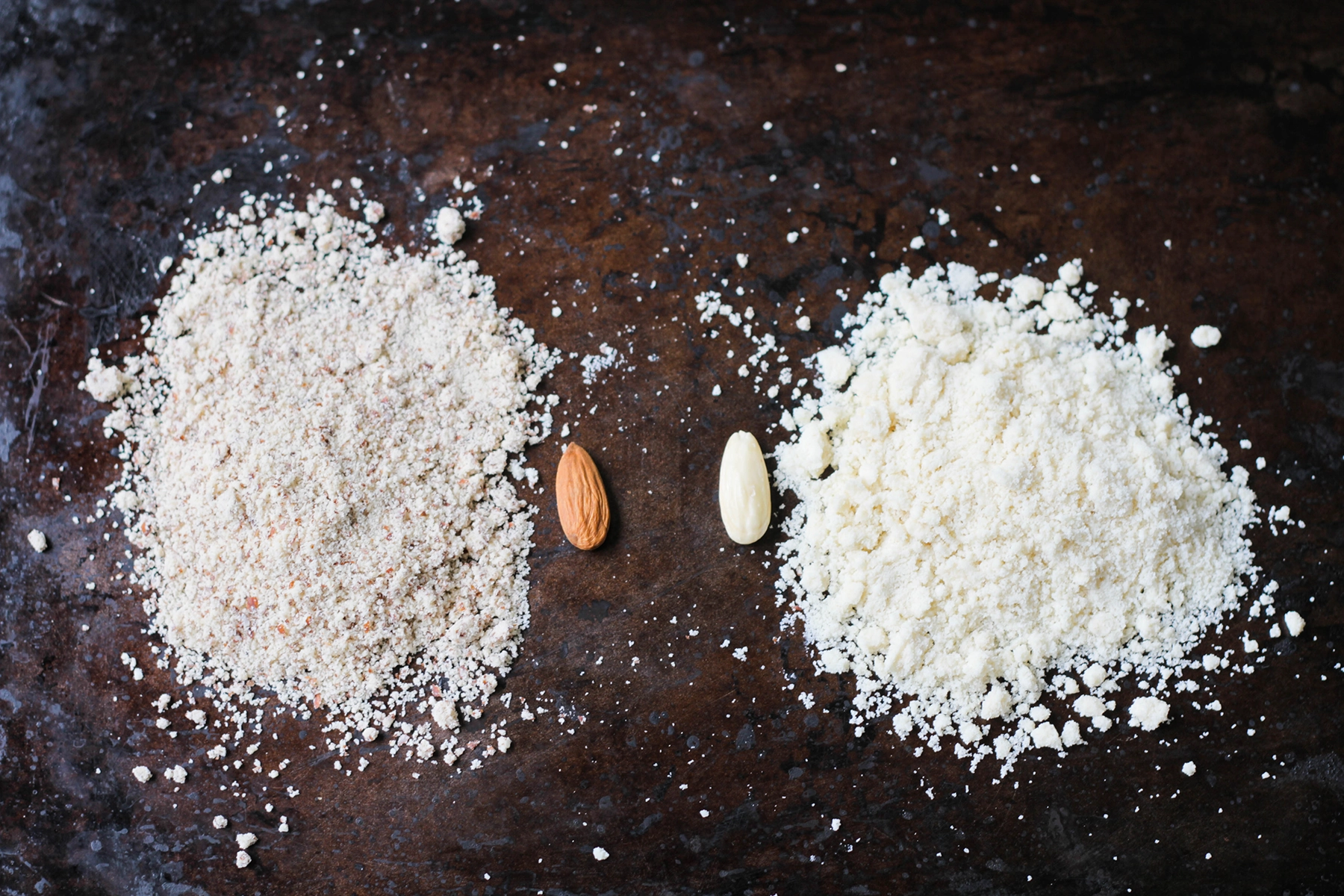
The first time I baked a recipe with almond flour it was not at all what I expected. And then I discovered that almond flour can mean a lot of things: almond meal, ground almonds, and blanched almond flour.
Since then I've found that finely ground blanched almond flour works best in most cases. Blanched almond flour works especially well in recipes that are designed to produce lighter, cake-like or cookie-like results.
In comparison to blanched almond flour, almond meal works well for more rustic baked goods, when you don't mind your result being a bit denser and slightly grainy (from the skins). It can be purchased (ground up almonds with the skins on), or you can make it yourself by grinding almonds (raw or roasted) in a food processor or other tool for creating whole grain flour.
Why use almond flour?
Why use blanched almond flour? I started out using almond flour because I wanted to eliminate all wheat and gluten for a while to see if it would help my son. And then I found that it eliminated my underlying anemia I have had on and off since giving birth to my each of my sons, and gave me a good boost of essential vitamins and minerals, including iron and calcium and vitamin E. It also has a higher protein content (and lower carbohydrate content) than other flours and baked goods. So baking with almond flour is quite healthy-a nice bonus.
Where to buy almond flour
Here are some sources for blanched almond flour:
- Trader Joe's
- Hughson Nut, Inc.
- Honeyville Food Products
- Amazon.com
- SunOrganic Farm
- Wellbees
- Bob's Red Mill
- Nuts.com
- JK Gourmet
- Costco
How to measure almond flour
While I usually use cups to measure almond flour, measuring by weight is technically more accurate. If you prefer measuring ingredients by weight, choose Metric below the ingredients list in the recipe.
What about other nut flours?
There are other nuts that make great flours, such as cashew, hazelnut, peanut, and pecan. I use them sometimes, but I mainly use almond flour due to it's mild flavor and that fact that I have it on hand. Nut butters are also good in some recipes, such as baked goods that are softer and/or denser, such as cookie bars, cakes and breads.
How to store almond flour
When I'm using it often I store it sealed at room temperature in my pantry. If I'm not going through it quickly I store it sealed in a refrigerator for a few months at a time. I purchase 25 pounds of almond flour at a time and it lasts me about 3 months or so, but it would depend on how often you use it. It's obviously cheaper to buy it in bulk, but you can buy it in smaller increments, such as 1 and 5 pound bags. It's a good idea to store it sealed in the refrigerator since it does tend to absorb odors from other food. I know some folks freeze it but I haven't found it necessary to do so. I imagine you could freeze some of it (tightly sealed) and defrost it as you use it.
Can you make your own?
Yes, but I'll admit up front that I don't, mostly because I never get the flour as finely ground as the flour that I buy. The finer the grind of flour, the more closer your baked goods will resemble the texture of a cookie or cake.
You can use a blender or a food processor to grind the almonds into flour, but to obtain blanched almond flour you must first blanch the almonds to remove the skin. And don't go too far when processing the almonds into flour, or you will end up with almond butter (which it not a bad thing, but not what you were after).
Another way to make a small batch of blanched almond flour is to purchase sliced blanched almonds and then process them until you have flour.
Do you need to sift almond flour?
I don't go as far as sifting it but I do break up any clumps before measuring it. If you are after the finest flour possible you could sift it a bit but in general ground blanched almond flour is good to use out of the bag. And a good mixing of your batter will disperse and break up clumps as well.
Can you use all-purpose flour (APF) in place of almond flour in a recipe?
Possibly, but it will depend on the recipe and the other ingredients. Almond flour is denser than APF and many other baking flours, so it behaves differently in each recipe. The biggest difference is that APF contains gluten as a binding agent, and almond flour doesn't so it relies on other ingredients to hold it together. Almond flour also tends to burn at higher temperatures, so generally you'll want to stay at or below 350°F (180°C, or gas mark 4) when baking recipes that call for almond flour as the main ingredient.
Deborah says
I am making dog biscuits using superfine almond flour, banana, and peanut butter. It is so oily I can't roll it out. I've added more flour, however, it doesn't help. I previously used all purpose flour but decided not to use any more. Any suggestions what to do?
Erica says
I don't use almond flour to make dog biscuits; I use oat flour most of the time.
Kim says
I use Bob's Red Mill "super-fine almond flour" it doesn't even need to be sifted.
Erica says
Thanks for the tip!
George Ik says
Can almond flour produce biscuit of the same quality (taste and texture) as wheat flour? ...
Erica says
The texture can be close, but not identical. I have some biscuit recipes on this site and in my coconut flour cookbook that come close.
Marlene Spadea says
My comment is already out
Marlene Spadea says
I too would like to know about the women that wrote about Pizzelles.
What she would substitute for flour and sugar.. I wouldn't use agave. She did mention that.
I hope someone can answer her and me. Please
It is like she said a pricey recipe. Especially too if you use anise oil, and I do.
Lori Kaumans says
You've probably learned this by now but yes, almond flour is higher in calories although I've found it to be more filling so find I eat less of it.
Angie says
As I do most of my grocery shopping at Costco, I'd like to buy it there. Does anyone know if it is available there? I don't recognize any of the brands. Do any of the nut companies like Blue Diamond, Emerald, or Diamond make almond flour?
Erica says
the almond flour brands are a bit different than the "usual" brands, but Costco definitely carries Honeyville in many locations and it's a trusted brand.
Teri says
Blue Diamond does and its on Amazon Prime.
Katy G says
I'm just making pizza crust with almond flour for the first time today. My method for making the flour is to use my leftover pulp from making almond milk, dehydrating it at 120 for 4-6 hours, then blending it in my Vitamix with the grain grinder attachment. I didn't have quite enough homemade for my recipe, so I used Bob's Red Mill and the consistency wasn't at all the same. Mine was much finer, more like real flour, compared to the coarse texture of Bob's. Also with mine, the skins are left on, no need to worry about blanching. I know which one I prefer. If you haven't tried this method, maybe give it a shot, plus you don't have to worry about turning it into butter.
Lisa says
In the book "Breaking the Viscious Cycle", Elaine speaks to the reason for the anemia being due to microvilli trauma.
Erica says
Yes, there is serious nutrient lost due to villi damage. I don't have IBD though.
Vicky says
I LOVE cooking with almond flour and despite the negative reports about it recently, I much prefer it to coconut flour since we limit the amount of eggs we consume!
That said, we don't eat baked goods everyday, just occasionally! I also suffer form hypothyroidism and despite drinking almond milk and including almonds in my diet regularly my meds have recently been reduced. I will try to find out more information about this though. Interesting point!
Erica says
Yes, there is a lot of information, both positive and negative, and I'm not sure how accurate it all is, but I think like most foods, eat it in moderation.
Sam says
Hi there. Is almond meal a 1:1 ratio as gluten free all purpose flour? I've always been curious to know.
Erica says
It can be, but usually it depends on the recipe and other ingredients.
N. says
I am intrigued by your statement that you think using almond flour helped solve your anemia.
What kind of anemia did you have (iron, B12)?
In what way do you think the almond flour helped? Does it have a high level of iron?
Do you think if you returned to eating wheat flour or other foods that contain gluten, the anemia could return, or was the anemia not directly related to that aspect of your diet?
I ask because I have an iron deficiency (as diagnosed by GPs and blood tests) that has not responded very well over the years to daily iron tablets (nor to a reluctantly-increased consumption of animal products, even though I'd rather be a vegetarian), and I am beginning to wonder if I might also have a B12 deficiency due to some scary neurological and other health problems I've been having of late.
---
In any case, I am not sure how much almond flour I would be safe to use in my cooking. I have had subclinical hypothyroidism for 20 years and there is a family history in my maternal line of total thyroid shutdown in midlife, so I try to avoid foods that contain goitrogens. Before I knew that almonds were goitrogenic, there was a period of about 2 years when I drank an 8 ounce serving of almond milk (homemade) every day, but when I found out they contained goitrotens, and then learned (by contacting the manufacturer) that the the soymilk machine which I was using to make my almond milk probably did not reduce much of the almond goitrogens during processing, I switched to making/drinking coconut milk and cut down my ingestion of almonds. I still eat a small serving of roasted almonds about four times a month, so I don't avoid them entirely, but I am not sure if using almond flour in everyday baking/cooking would be risky for my thyroid or not. I am also not sure about the goitrogen situation with almond flour - if factory-processing of almonds into flour eliminates some of the goitrogens, and/or if baking with almond flour destroys some of the goitrogens via the moderately-high oven temperatures.
Erica says
I'm not sure why I had anemia, but I no longer have it. I do eats lots of almonds 🙂 so that probably helps quite a bit.
Sharon B says
I've tried making almond flour twice. The first time by blanching, slipping off the skins, and grinding. This results in a moist flour because of the oil in the nuts. The second time, I dried the leftover pulp after making almond milk (with blanched, skinless nuts). I then used my 'coffee' grinder to powder it. This makes, naturally, a drier flour.
Unfortunately, I never have enough flour made to compare their qualities for baking (I'm the only one who will drink the almond milk). Also, never having bought commercial brands of flour (expensive!), I don't know if they're de-fatted (remainders after making almond milk).
So -- after that long ramble -- have any of you compared different methods of making the flour, with commercial brands?
P.S. I don't have a nut milk bag, so I use the leg of a never-worn(!) Sheer Energy pantyhose to strain/squeeze pulps.
Mariana says
Thank you for this site, it's amazing, I really enjoy it. I am just starting with the Paleo eating and am trying to adapt my old recipes to this new flourless baking style.
I have found great help in your site, and combining my own recipes with yours have helped me accomplish really good things, so thank you for that.
I am still confused, however, regarding blanched almond flour. I live in Budapest, Hungary and it is easy to find, but there is a place where I can get 200mg of clearly blanched almond flour, because the product is white, and I also have bough organic almond flour, which turns out to be less oily but deep brown. I am begining to suspect the 200mg white version to be almond meal, because you can still feel some oil when rubbing it between your fingers. The brown one is dry however, I buy it from a guy who also sells marzipan, almond milk, almonds (of course) and almond butter.
Could you tell me if it's safe to use this almond flour (brown and dry) in lieu of the blanched almond flour most recipes require? Or should I then make some adjustments, as it is so dry?
Thank you so much!!!
Erica says
My guess is that if the flour is deep brown it is not blanched almond flour, but more likely it is almond meal (skins still on the almond). It does depend on the recipe, but in general you want to use blanched almond flour (the white/yellow stuff), not almond meal (the brown stuff). That said, some of my recipes work with either kind of flour, but the baked product will have a different color and texture. The baked breads usually work well with either, but cupcakes and yellow cake don't work well with almond meal.
Henriette says
I think the brown flour is defatted high fibre almond flour.
It works rather different than regular blanced almond flour.
You need more liquid and it contains less fat.
It is ratherpopular here in Europe.
Lovely blog btw I eat a paleo Low carb high fat diet and I have used several f your recipes with good result.
Liz says
Hi. I just love your website. Thank you for sharing all of your ideas, tips and recipes. I also have a food blog and teach cooking classes to children. It's a lot of fun and the kids learn so much. Anyway, I have been doing a lot of GF baking lately and have become obsessed with oat flour. Have you tried using GF oat flour? I just started incorporating some almond flour into recipes too, however, my kids don't bring any nut foods to school so I would rather stick with oat flour and coconut flour. Let me know your thoughts. Thanks.
Erica says
ok, don't laugh, but I've only used oat flour in dog biscuits. I'll probably get to it one day. that's great that you teach kids to cook! Love that. yes, nuts are not good for public environments, especially schools. I'm curious about millet actually. Best wishes, Erica
Dee Hoevenaars says
i have a blueberry muffin recipe that calls for 1/4 cup almond flour. Can I just substitue regular flour , other than lighter does it ruin the recipe??
Nancy Heitschmidt says
I would use cake (wheat) flour as it is a fine consistency like almond flour.
Alvin says
I have a recipe which calls for almond flour but my daughter is allergic to almonds. Can I just substitute all purpose flour with almond flour and get (more or less) the same results?
Anyone have an idea out there?
Thanks
Brittany says
Does anyone know if almond meal or pecan meal cake has less calories than using regular flour? I know if has less carbs, but I am wondering if it really amps up the caloric count if you switch to a nutty "meal?" Especially if you are able to digest regular flour. Thanks!
Vicki says
Trying to use Almond Flour as a crust for quiche and was wondering if you had found a way to make it light and flaky like a nice pastry tart crust? Thanks for sharing!
Missy says
Hi Erica, Which of the brands is the finest grind? I'm in a macaron making frenzy and the Bob's Red Mill is too coarse to sift (I lose about 1/2 of the volume). Any suggestions? Thanks!
Erica says
Honeyville Grain seems to have fairly fine grains. I'm wondering what others use when making macarons. I have some you can try.
Faith says
I process my own using slivered almonds, which is already blanched. I process it in a coffee grinder and run it thru a sieve. Check out how I do it on my blog: https://faithepp.blogspot.com/2011/11/how-to-make-almond-or-rice-flour-in.html.
Carol T says
I was diagnosed with celiac about seven years ago, went diary free about 3 years ago and recently was pulled off refined sugar by my doctor. I am feeling anxious about figuring out how to make pizzelles for Christmas (a family tradition). Can you help me figure out how to make them using blanced almond flour and an alternate sugar (maybe agave or honey)? I can't afford to waste the expensive almond flour I bought.
Nancy Heitschmidt says
KI, too, felt almond flour was extremely expensive. My husband has been on the Specific Carbohydrate Diet for 6 weeks & he was ready for a treat. I have made several batches of muffins with almond flour &/or corn meal. All gone within 24 hours. I also made cupcakes when we went to his brother's birthday party. They were a bit soft so I know to add a bit more flour. I found the best price for both is Honeyville at $5 per pound.
Martine says
why not to use unblanched almond ?
Thanks
Aliyah7 says
Loved this post. This will help me a lot in my decision on which Almond flour to use and for which purposes. Thanks!
Claire Patty says
Here in the Czech Republic we can buy big bags of blanched almonds. It's great, because then I can make my own almond flour with no hassle! I can't buy almond flour, but hey, blanched almonds will do! 🙂
Erica says
Wow. And how's the price on those almonds compared to the US? I guess they're not from California 🙂
Erica says
Hi Roxanne. No problem. It can be a bit tricky - it kind of depends on the recipe. It can be a 1:1 conversion, but not always. Good luck! Let us know if you have success.
Tammy says
Question - When baking from scratch and replacing wheat flour with almond flour - can you use the same amount? Do you need to add other ingredients as well to get the same results?
Roxanne says
SO sorry, the previous question didn't show up when I was looking through these. I see now that the ratio is 1:1
Roxanne says
How do you normally adapt a regular recipe to using almond flour (like you said the honey and sugar was a 1:1 conversion)? I want to make some squash muffins and the recipe calls for 3 c. regular flour....not sure what almond flour equivalent that would be....guess I could just eyeball it and see....yikes! Almond flour is just so expensive I hate to waste it 🙁
Erica says
Hi Tammy. Sometimes you can replace almond flour at a ratio of 1:1, but not always. And it depends on the recipe. Sometimes replacement doesn't cut it at all. That's probably not the answer you were hoping for, but that's what I've found.
Erica says
Geez, thanks for letting me know! My domain host, ironically named Hosting Matters, Inc, goofed, sent me a note that they automatically bill me, but then didn't renew it. I was out all afternoon. I just got customer support to respond and they re-linked the domain name.
Ellie says
What happened to Comfy Belly? When I type comfybelly.com in I don't get your site!!
EricaKerwien says
I'm glad I'm not the only one! Thanks for commenting - and I love your blog. I'm going to attempt an inspired tart real soon...
Tony says
I practically live off almonds! by far the best nut out there 🙂